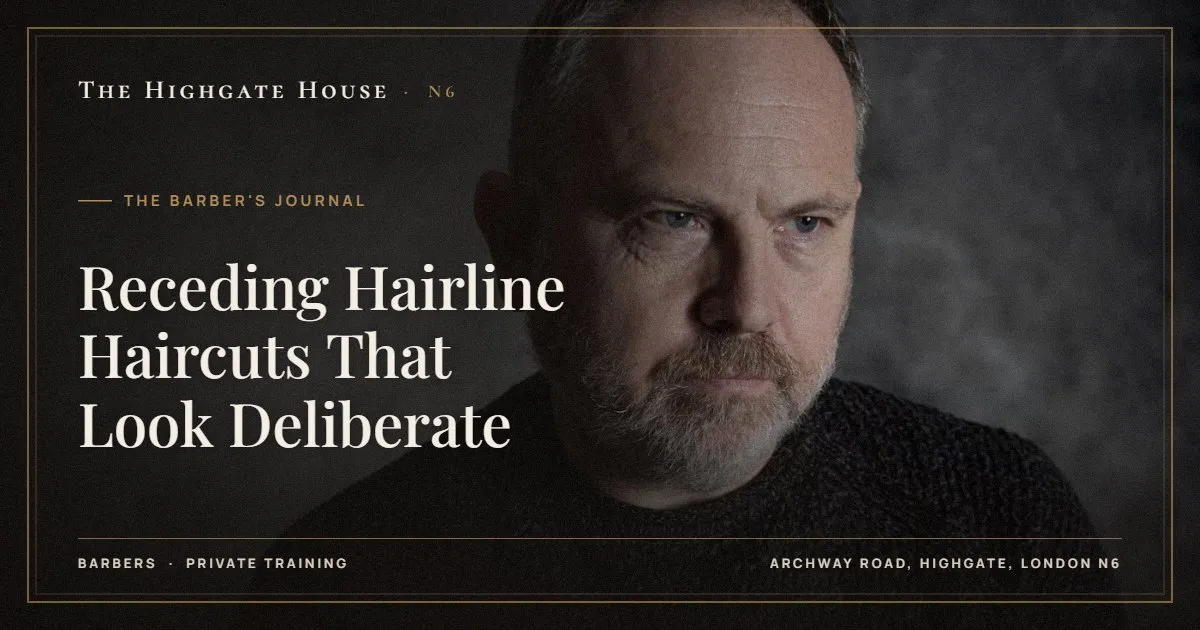
Receding Hairline Haircuts That Look Deliberate
The haircuts that suit a receding hairline best are shorter cuts with texture on top and tighter sides: a textured crop, a short brush-up, a short back and sides, an Ivy League cut or, at a later stage, a buzz cut. They work because they reduce the contrast between the fuller middle of the hairline and the receding temples, and because short sides make the top look denser. What makes a receding hairline look worse is length: long hair swept back or to the side draws a line straight to the gap. The best cut changes as your hairline does, so the right answer depends on your stage.
What is actually happening at the temples
Most men’s hairlines move back slightly in their late teens and twenties as the boyhood hairline becomes a mature one. That is normal and often stops after a centimetre or so. In male pattern hair loss, the temples continue to recede, often forming an M shape, and the crown may thin as well. The NHS hair loss page describes male pattern baldness as hereditary and very common.
A barber cannot change any of that, but a barber can change how much people notice it. If you are worried about sudden or patchy loss, or loss alongside other symptoms, that is a question for your GP rather than a haircut. Our post on what your barber sees when hair starts to thin covers when it is worth getting checked.
Choose the cut by stage
Barbers think about receding hairlines in rough stages. You do not need a formal scale; a look in the mirror with your hair pushed back is enough.
| Stage | What you see | Cuts that work |
|---|---|---|
| Mature hairline | Slight, even rise; temples a finger-width back | Almost anything, including side partings and quiffs |
| Early recession | Temples clearly behind the centre; soft M shape | Textured crop, short brush-up, Ivy League, short quiff |
| Noticeable recession | Deep M; centre sits forward as a peninsula | Short textured crop, French crop, crew cut, Caesar |
| Advanced | Temples meet thinning on top or at the crown | Buzz cut, very short crop, or a clean shave |
The cuts in more detail
Textured crop
Short sides, a few centimetres on top, cut with texture and pushed slightly forward. The forward direction covers the temples without looking like a cover-up, and the texture breaks up the line where the hairline recedes, so the eye reads the top as one mass rather than a fringe with gaps either side. This is the most common recommendation for early to noticeable recession. See our guide to the textured crop for how to ask for it.
Short brush-up or Ivy League
Instead of pushing hair forward, these lift it slightly up and back from a short, tidy front. That sounds counterintuitive, but if the front is kept short, there is no long fringe to separate and expose the corners. The Ivy League has a slight side part, which can be placed on the side where the recession is milder.
Crew cut and Caesar
Shorter still. A crew cut graduates from a little length at the front to shorter at the crown; a Caesar has a short, straight, forward fringe. Both suit men whose central patch has started to sit noticeably forward of the temples.
Buzz cut
At some point the most deliberate option is to go very short all over. A uniform length makes the hairline matter far less, because there is so little contrast between hair and skin. It is also the lowest-maintenance cut there is. If you are close to that decision, our post should you shave your head walks through it.
Why short sides help
This is the part men find surprising. Keeping the sides and back short, with a taper or a low to mid fade, makes the top look thicker by comparison. Bulky sides with a thin top do the opposite: they frame the area that is receding. A tighter outline also squares off the head shape, which balances a higher forehead.
The one caution is very high skin fades on someone with significant recession. Taking the sides right down to skin high up can join visually with the bare temples and make the hairline look further back. A low or mid fade, or a scissor-over-comb taper, is usually kinder.
Mistakes that draw the eye to the temples
- Growing it long to compensate. Longer hair separates, especially when damp or windblown, and the gaps show more.
- The comb-forward. Long hair combed forward over the temples fools nobody, and it moves.
- Slicked-back styles with shine. Gel or high-shine pomade pulled back exposes the full hairline and makes the scalp reflect light.
- Too much product. Heavy products clump fine hair into strands and show the scalp between them. A small amount of matt clay or paste is better.
- A hard line-up at the front. Sharpening the hairline with a razor or trimmer pushes it back. With a receding hairline the front edge is best left natural.
- Waiting too long between cuts. As length builds, the cut loses its shape. Short cuts for receding hairlines need trimming every three to five weeks to keep working.
What to tell your barber
Every visit at Highgate Cuts starts with an assessment: the barber looks at your hair and hairline and makes recommendations before cutting. You can make that conversation more useful by being open about it. Barbers see receding hairlines every day, and the more honest you are, the better the cut.
- Say plainly: “My temples are receding and I want a cut that works with that.”
- Tell them how you style it in the morning and how long you will spend.
- Show a photo of a cut you like on someone with a similar hairline, not on someone with a full one.
- Ask them not to line up the front.
- Ask which product they would use and how much, and watch how they apply it.
You can read more about our cuts on the Highgate Cuts barber page.
Questions we get asked
Is a fringe a good idea with a receding hairline?
A short, textured fringe, as in a crop, usually works well. A long, heavy fringe tends to split at the temples and show the gaps, especially by the end of the day.
Does a beard help?
It can balance the face. A short, well-kept beard adds weight to the lower half, which makes a higher forehead less dominant. Keep it neat and in proportion to a short haircut.
Will cutting it short make it recede faster?
No. Cutting hair does not affect the follicles. Short hair simply makes the hairline easier to see clearly, which is why the right short cut matters.
How often should I come in?
Every three to five weeks for most short cuts. Book with the barbers on Archway Road by email.
Book with The Highgate House
Ready for a proper cut? Email us at [email protected] with the service and the day that suits you, and we will come back to you with times.
Visit The Highgate House · The barbers
The Highgate House, Archway Road, Highgate, London N6.
