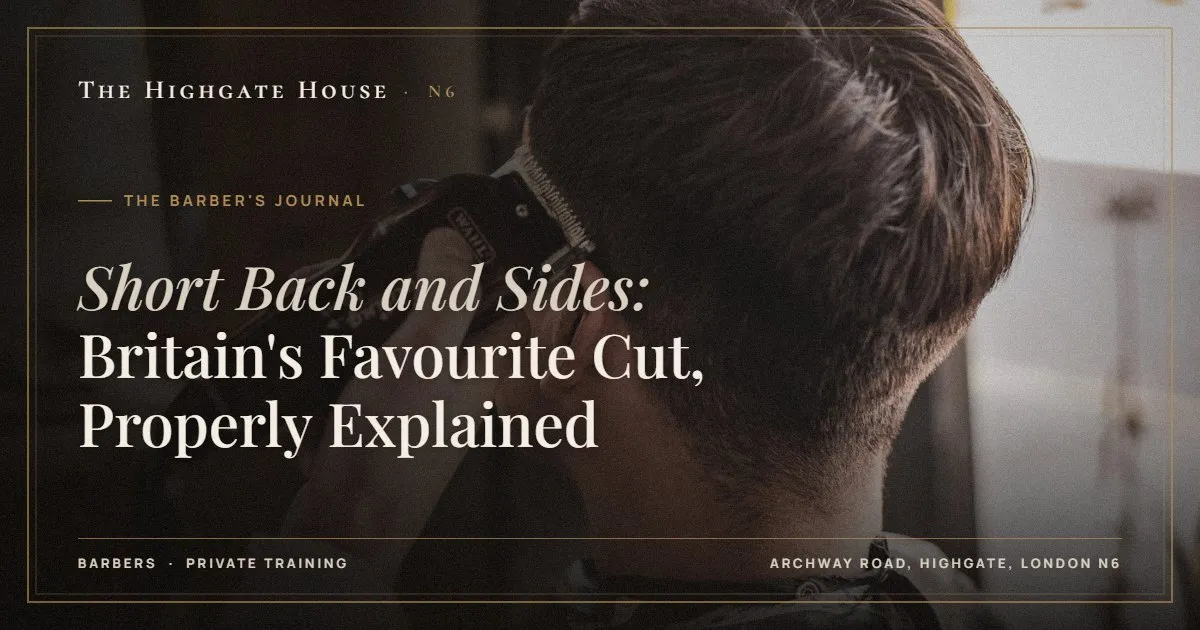
Short Back and Sides: Britain's Favourite Cut, Properly Explained
A short back and sides is a men’s haircut where the hair at the back and sides is cut short and tapered towards the neck and ears, while the top is left noticeably longer. That is the whole definition, and it is why the phrase causes so much confusion: it describes a family of cuts, not one cut. “Short” might mean a number two clipper or a centimetre of scissor-cut hair; the top might be two centimetres or ten. To get the version you have in mind, you need to specify three things: how short the sides go, how the neckline is finished, and what happens on top. This guide walks through each.
Where the phrase comes from
The short back and sides became the default British men’s cut in the first half of the twentieth century. Military regulations and practical concerns about hygiene kept hair short around the ears and collar, and the style carried into civilian life, office life and school photographs for decades. It never really left. What changed is the toolkit: once clippers with fine guard sizes became standard, barbers could produce much shorter and more graduated sides than the scissor-and-comb versions of the past.
That history explains why older clients and younger clients can say the same three words and mean different things. For someone who grew up with it, it often means a tidy, scissor-led cut with a soft taper. For someone younger, it can mean anything from a crop to a clipper cut that is a step short of a fade.
The three decisions inside a short back and sides
1. How short the sides go
This is the biggest variable. As a rough guide:
| Side length | How it’s usually cut | Look |
|---|---|---|
| Very short (grade 1 to 2) | Clippers, tapered lower down | Clean, sporty, scalp visible at the edges |
| Short (grade 3 to 4) | Clippers or scissor over comb | The classic office version; neat without looking severe |
| Longer, soft | Mostly scissors | Traditional and gentle; the sides still cover the scalp |
If you are not sure what the numbers mean, our guide to clipper guard numbers converts them into millimetres.
2. How the neckline is finished
The back of the cut ends in one of two ways. A tapered neckline graduates down to the natural hairline, so as it grows it simply gets slightly longer. A blocked (squared) neckline has a straight horizontal edge across the bottom, which looks crisp for a week then shows the regrowth underneath. Most men find a taper easier to live with; the trade-offs are covered in tapered vs blocked neckline.
3. What happens on top
The top is where personal style lives. A short back and sides can carry a side parting, a short textured crop, a forward Caesar-style fringe, or enough length to push back. Say how you wear it in the morning, not just how you want it to look after the barber has styled it.
Short back and sides vs a fade
This is the distinction people most often ask about. A fade takes the sides down to very short or bare skin at the bottom, with a smooth gradient up. A short back and sides keeps more length on the sides overall and is graduated more gently, usually without reaching skin. The practical differences:
- Growth. A short back and sides grows out quietly over four to six weeks. A skin fade loses its contrast within a fortnight.
- Formality. A short back and sides suits almost any workplace without comment. Fades range from very discreet to very visible depending on height.
- Head shape. Because more hair stays on the sides, a short back and sides is more forgiving of scars, a flat back of the head or uneven contours.
The two meet in the middle: a very low, soft fade and a short clipper-led short back and sides can look almost identical. If you want to understand how a fade is constructed, what is a fade haircut goes through the blend step by step.
Scissors or clippers?
Both produce a good short back and sides; they produce slightly different ones.
- Clipper-led cuts are faster, more uniform and can go shorter. They suit straight, dense hair and men who like a very tidy result.
- Scissor-led cuts, using scissor over comb on the sides, leave a softer texture and are better at following the shape of the head. They suit fine, wavy or greying hair, and men who find clipper cuts look a little harsh as they grow.
Many barbers use both: clippers low down around the ears and nape, scissors higher up to blend into the top. Tell the barber if you have a preference, and they will explain what suits your hair during the assessment that starts every visit.
How to ask for one
Here is a short checklist you can take into the chair:
- Side length: a number if you know it, or “short enough to see the scalp at the bottom” or “short but still covering”.
- Clippers, scissors or both.
- Neckline: tapered or squared.
- Around the ears: fully cleared, or a little hair left over the top.
- Sideburns: where you want them to stop, usually mid-ear or top of the ear.
- Top: how much off, how you part it, and what product (if any) you use.
- Last time: what you liked and did not like about your previous cut.
Two minutes spent on that list removes nearly every misunderstanding. A photo of your hair at its best, taken a week after a cut you liked, is often more useful than a picture of someone else.
Upkeep and how often to book
Most men keep a short back and sides looking right by returning every three to five weeks. Shorter sides need booking at the earlier end; a soft, scissor-cut version can stretch to six. The first thing to go is the neckline and the area around the ears, so if you want to extend the gap, keeping those tidy helps more than anything else. If you would like a barber’s opinion on the right interval for your hair, the Highgate Cuts team on Archway Road will suggest one at the end of the cut.
Who it suits
Nearly everyone, which is why it has lasted. It works on straight, wavy and many curly hair types, on thick and thinning hair, and on any age. Where hair is thinning on top, keeping the sides short and neat reduces the contrast between the sides and the crown, which makes thinning less noticeable. Where hair is very thick, the barber will usually remove bulk on the sides so the cut does not puff out after a week.
Questions we get asked
Is a short back and sides the same as a crew cut?
A crew cut is one version of it, with a very short top graded from front to back. A short back and sides can carry much more length on top.
Can I ask for a short back and sides with a fade?
Yes. Many barbers will read that as a low, soft fade at the bottom with a classic shape above. Say so directly and point to where you want the shortest part to stop.
How long does it take?
It depends on the hair and how much scissor work is involved; a soft, fully scissor-cut version takes longer than a clipper-led one. Ask when you email and we will tell you how long to allow.
What does it cost?
We have not published prices yet. See the barber menu or email us and we will tell you.
Book with The Highgate House
Ready for a proper cut? Email us at [email protected] with the service and the day that suits you, and we will come back to you with times.
Visit The Highgate House · The barbers
The Highgate House, Archway Road, Highgate, London N6.
