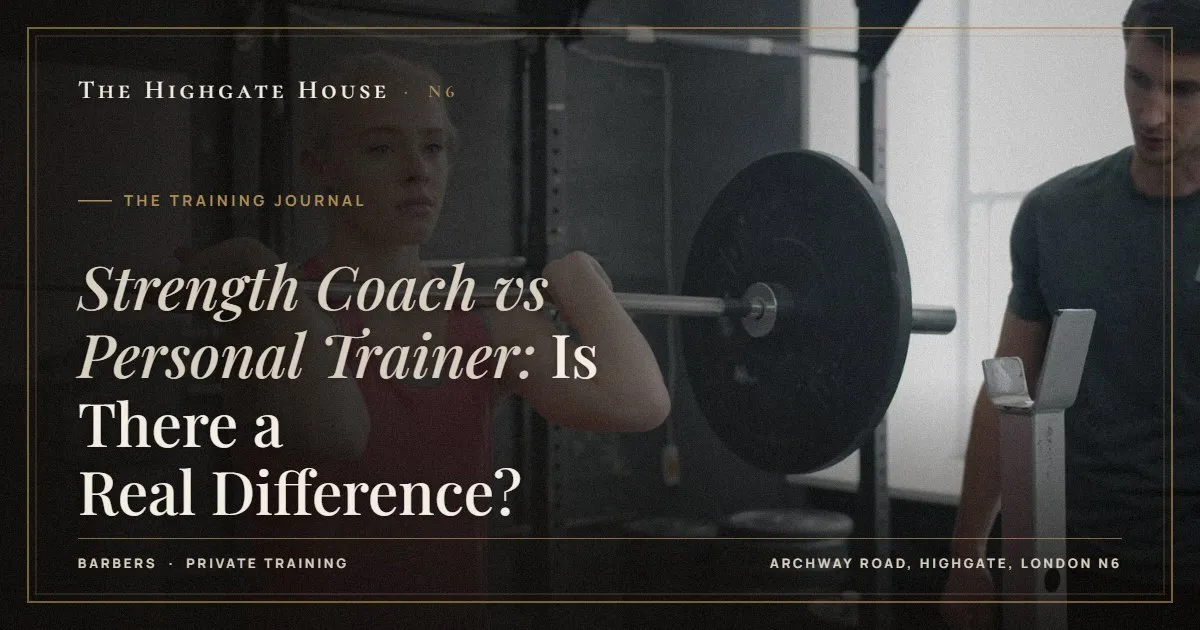
Strength Coach vs Personal Trainer: Is There a Real Difference?
There is a real difference, but it is about context more than talent. A strength and conditioning coach traditionally works with athletes and teams, building physical qualities that serve a sport, usually through a structured, long-term plan. A personal trainer works with members of the public, one to one, around their health, body composition and life. In practice the best personal trainers coach strength like a strength coach, and the job titles tell you less than how someone programmes, progresses and explains. For a busy adult, the useful question is not which title, but which way of working.
Where the two roles come from
Strength and conditioning grew out of sport. The coach’s client is an athlete, the goal is performance on a pitch, court or track, and the gym work is one part of a bigger picture that includes skill training, competition and recovery. A strength coach thinks in seasons and blocks, measures outputs such as speed, jump height and maximal strength, and is judged on whether athletes perform and stay available to play.
Personal training grew out of the commercial gym. The client is a member of the public, the goals are broader (fat loss, health, confidence, rehab after a niggle, feeling stronger at 45), and sessions often double as accountability. A personal trainer is judged on whether the client turns up, improves and stays.
Both are legitimate. They simply solve different problems. The overlap has grown in recent years: more personal trainers now programme around the big barbell lifts, and more strength coaches work with adults outside sport, especially older clients who want to stay strong. That is why the titles have become blurred, and why reading the label alone is a poor way to choose.
Qualifications: what each title usually means in the UK
Neither title is legally protected in the UK, so anyone can use either. That is worth knowing before you put weight on a label.
- Personal trainer. The industry standard is a Level 3 personal training qualification, with the Level 2 gym instructor qualification beneath it. Our post on personal trainer qualifications in the UK explains the levels and what they cover.
- Strength and conditioning coach. Often holds a sports science or S&C degree, and in the UK the recognised professional body is the UK Strength and Conditioning Association, which runs its own accreditation with a practical assessment. Many people calling themselves strength coaches hold neither.
Qualifications are a floor, not a ceiling. Years of coaching real people, and how someone answers your questions, usually tell you more.
How the day-to-day coaching differs
| Typical strength coach | Typical personal trainer | |
|---|---|---|
| Planning horizon | Months, around a competitive season | Varies widely, sometimes session to session |
| Core tools | Barbell lifts, jumps, sprints, loaded carries | Anything from barbells to machines to circuits |
| Measures | Strength, power, speed, conditioning tests | Weight, body composition, how clothes fit, attendance |
| Format | Often groups or teams | One to one |
| Lifestyle input | Usually limited; other staff cover nutrition and medical | Often central: sleep, food, stress, habits |
These are tendencies, not rules. There are personal trainers who programme more rigorously than some team coaches, and strength coaches who are excellent with ordinary adults.
What a busy adult actually needs
Most professionals over 30 do not need sport-specific power work. They do need the parts of strength coaching that make training effective, combined with the parts of personal training that make it fit their life. In my experience that means:
- A plan with a direction. Weeks that build on each other, with the main lifts progressing. The principle is progressive overload, and it is non-negotiable.
- Measured progress. Logged weights and reps, and periodic body composition scans rather than guesswork.
- Technique that holds up under load. The squat, hinge, press and pull, coached until they are reliable.
- Conditioning in sensible doses. Short, hard intervals and easy aerobic work, not exhaustion as a goal.
- Adaptation to real life. Bad sleep, a heavy work week, a trip abroad. The plan bends without breaking.
That combination is what I aim for in the studio: strength-coach programming delivered one to one, in a private room, with the attention to life outside the gym that personal training does well. The kit reflects it: a squat rack, barbell and plates, dumbbells, a two-stack cable station, lat pulldown, seated row, an air bike and an InBody scanner. You can see how this fits together on our Highgate personal training page.
How to tell how someone coaches, whatever they call themselves
Ask these in a consultation and listen carefully to the answers.
- “What will my main lifts be, and how will you progress them over the next twelve weeks?”
- “How do you decide when to push harder and when to pull back?”
- “What do you track, and will I see it?”
- “What would you do if I came in after four hours’ sleep?”
- “When would you refer me to a physio or my GP?”
A vague answer to the first question is the most telling. For more, see our list of questions to ask a personal trainer before you commit.
When a specialist strength coach makes more sense
If you compete seriously in a sport, are preparing for a specific performance test, or want to enter powerlifting or weightlifting competitions, a coach with a sport-specific background is worth seeking out. The same applies if your club or team already has one. For general strength, health, body composition and longevity, the label matters far less than the method.
If you have a heart condition, a significant injury, are pregnant or are returning after a long time away from exercise, check with your GP before starting any heavier strength programme.
Questions we get asked
Is a strength coach more qualified than a personal trainer?
Not necessarily. Some are, through degrees and accreditation. Some are not. Check the specific person’s background and experience rather than the title.
Will strength-focused training make me bulky or slow?
No. Adding muscle is slow and deliberate. Most adults simply become stronger, move better and find everyday tasks easier.
Can a personal trainer help me with a sport?
Yes, for general strength, robustness and conditioning that support most recreational sport. For elite or highly technical performance goals, a specialist may be better.
What does Artem call himself?
A personal trainer, with more than ten years of coaching and training since he was 15. Sessions are built around strength. Read more on private 1-1 training at The Highgate House.
Book with The Highgate House
Ready to start training properly? Email us at [email protected] with the service and the day that suits you, and we will come back to you with times.
Visit The Highgate House · Private personal training
The Highgate House, Archway Road, Highgate, London N6.
