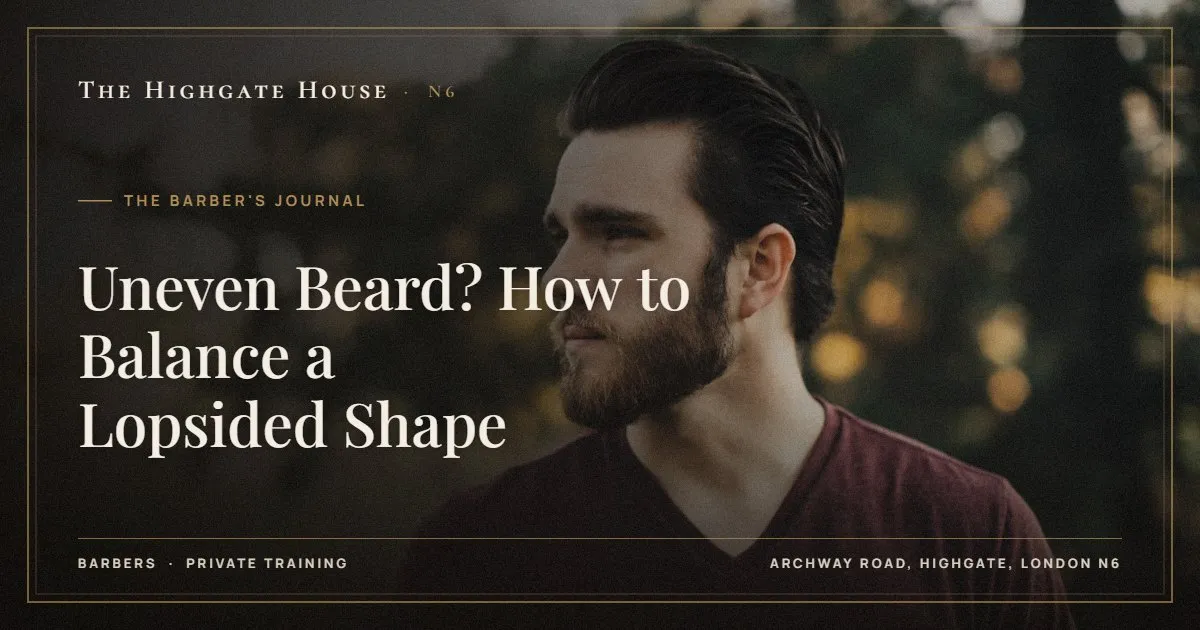
Uneven Beard? How to Balance a Lopsided Shape
Most uneven beards are a mix of two things: natural differences between the two sides of your face and growth, and small trimming errors that add up over weeks. You fix the first by cutting to balance what people see, not by making both sides identical in length. You fix the second by trimming from a fixed reference point, checking in a mirror from straight on rather than turning your head, and taking less off each time. Common fixes are lowering the cheek line on the fuller side, leaving the thinner side slightly longer, and combing the beard in its natural direction before cutting. If the shape keeps drifting, a barber can reset it so you only have to maintain it.
Below: how to work out what kind of unevenness you have, and how to correct each one.
Why beards grow unevenly
Very few faces are symmetrical. One side of the jaw is often slightly fuller or longer, one cheekbone higher, the chin a little off centre. Beard growth follows the same pattern: hair density, growth direction and even colour can differ between left and right. It is normal and, in a short stubble, nobody notices. As the beard grows longer the differences become visible, because hair that grows at a different angle or rate gives each side a different outline.
Other common reasons include:
- Growth direction. Hair on one side may grow forward and on the other side down, so the same length looks different.
- Cowlicks and whorls, often on the neck or under the jaw, which push hair outward on one side.
- Sleeping on one side, which flattens that side of a longer beard.
- Your dominant hand. Most people trim one side more accurately than the other.
- Thinner patches on one cheek or around the moustache corners. If that is your main issue, our guide to patchy beards covers it in more detail.
Diagnose before you cut
Do this before reaching for the trimmer. It takes two minutes and stops you chasing the problem round your face.
- Wash and dry the beard and comb it out in its natural direction. A damp beard looks shorter and hides the true shape.
- Stand square to the mirror in good, even light. Overhead bathroom light exaggerates shadows.
- Take a photo from straight on, at eye level, without tilting your head. The camera is more honest than the mirror, which you instinctively adjust to.
- Compare three things on each side: the height of the cheek line, the width at the jaw corner, and where the moustache ends.
- Check the length by pinching hairs at the same point on each side.
Now you know whether the problem is the outline (lines in different places), the bulk (one side fuller), or the length (one side longer).
Fixing each type of unevenness
| Problem | Likely cause | Fix |
|---|---|---|
| Cheek lines at different heights | Trimming error, or natural growth | Match to the lower line, using a fixed landmark |
| One side fuller or wider | Denser growth or growth direction | Take more bulk from the fuller side; keep length similar |
| One side thinner | Natural density difference | Leave the thin side slightly longer; avoid a sharp cheek line |
| Chin off-centre | Facial asymmetry or uneven trim | Find the centre from the nose and lips, not the chin |
| Moustache longer on one side | Trimming with one hand | Trim with the mouth relaxed, from the centre outward |
Cheek lines
Use a landmark that sits in the same place on both sides, such as the top of the ear or the corner of the eye, and set the line relative to it. Mark the line on the higher side first, then match the other side to it. Always move towards the lower line rather than trying to raise one: you can take more off, but you cannot put it back. Our guide to where the cheek line should sit covers natural versus defined lines.
Bulk and width
If one side looks wider at the jaw, use a slightly shorter guard on that side to reduce bulk, or use scissors over a comb to thin out the outer layer. Keep checking from straight on. The goal is that the two sides look the same width, even if the actual lengths differ by a few millimetres.
Thin side
Counter-intuitively, leave the thinner side a bit longer. Longer hair covers more skin and makes the density look closer to the other side. A softer, natural cheek line also hides a thin patch better than a crisp, high line.
The chin
Find the centre from the middle of your nose and the dip in your upper lip, then shape the chin from that line. If your chin itself sits a little to one side, shaping the beard to the true centre of the face, rather than the chin, often makes the asymmetry less noticeable.
Trimming technique that stops it happening again
- Use the same guard on both sides, and work in the same direction on each side.
- Do one pass on each side, then compare. Do not finish one side completely before starting the other.
- Swap hands for the side your dominant hand struggles with, or turn the trimmer around.
- Trim less, more often. Small corrections every week are easier to keep even than big ones every month.
- Know your settings. Our beard trimmer length guide helps you repeat the same lengths each time.
When unevenness is not just about trimming
If a smooth, round, bald patch has appeared in your beard quite suddenly, rather than being a long-standing difference, it could be alopecia areata, which sometimes affects beards. It is worth reading the NHS page on alopecia areata and speaking to your GP. Similarly, a red, itchy or scaly patch is worth showing to a pharmacist. A barber can work with these patches cosmetically, but should not diagnose them.
Having a barber reset the shape
If the beard has drifted badly, or you have tried to correct one side and the other has gone too short, the quickest route is a reset. A barber sees your face from the front, side and behind, works with both hands, and has the angles and outlines in their eye from cutting all day. At the Highgate Cuts barbers on Archway Road, every visit starts with an assessment: the barber looks at your beard, how it grows and what you want, then makes recommendations. Tell them which side bothers you and they will build the shape around it, so your weekly job at home is just to follow the lines. You can see the beard services on the barber page.
Questions we get asked
Is it normal for one side of the beard to grow thicker?
Yes. Small differences in density and growth direction between the two sides are very common.
Will an uneven beard even out as it grows?
Sometimes thin areas fill in over the first months. Differences in growth direction usually stay, and are best managed with the cut.
Should both sides be the same length?
Not necessarily. What matters is that they look balanced. Sometimes that means slightly different lengths.
How often should I have a barber reshape it?
Many men find every four to six weeks keeps the lines in place, with light home trims in between.
Book with The Highgate House
Ready for a proper cut? Email us at [email protected] with the service and the day that suits you, and we will come back to you with times.
Visit The Highgate House · The barbers
The Highgate House, Archway Road, Highgate, London N6.
