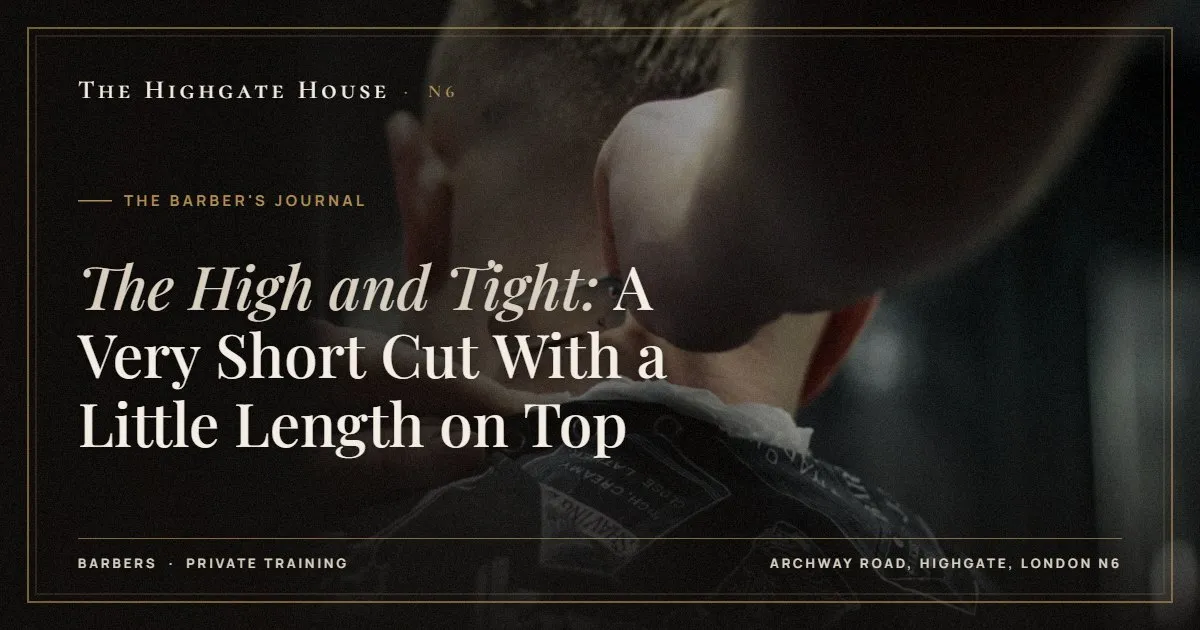
The High and Tight: A Very Short Cut With a Little Length on Top
A high and tight is a very short men’s cut in which the sides and back are clipped extremely close, often down to the skin, all the way up to the top of the head, leaving a small patch of slightly longer hair on top. It comes from military barbering and looks deliberate, clean and practical. The key difference from a crew cut is how high the short part goes: on a high and tight, the clipped sides reach the curve of the head (the parietal ridge) or above, so the top looks like a neat island. Ask for it by naming the length on top, the guard or skin on the sides, and whether you want a hard transition or a blend.
What makes a high and tight different
Short cuts are easy to confuse. The high and tight sits at the very short, high-contrast end of the family.
| Cut | Sides | Top | Overall effect |
|---|---|---|---|
| Buzz cut | Same as top | One even clipper length | Uniform, minimal |
| Crew cut | Short, tapered | Slightly longer, graded front to back | Classic, softer |
| High and tight | Very short or skin, taken high | Short strip or patch on the crown | Sharp, high contrast |
| High and tight recon | Skin almost to the top | A small, very short patch | The most severe version |
If you are torn between the gentler options, our guide to the crew cut versus the buzz cut is a good place to start. The regulation haircut is the tidier, more conservative cousin.
Who it suits
The high and tight puts the shape of your head on show. It suits:
- Even head shapes without a pronounced flat area at the back or prominent bumps on the sides.
- Strong jawlines and defined features, which are emphasised when the sides disappear.
- Thinning hair at the crown or temples, sometimes. Keeping everything very short reduces the contrast between thinner and thicker areas.
- Men who want the minimum of daily styling. Towel dry and go.
It is less forgiving if you have scars, a bumpy scalp or a rounded face you would rather balance with height on top. The assessment at the start of every visit is where a barber will be candid about that. If it is not right for you, a high fade with more length on top gives a similar sharpness with more softness; see the high fade haircut.
How to ask for a high and tight
“High and tight” means different things in different chairs. Give your barber specifics:
- The top length. A clipper guard number or a finger-length measurement, for example “a number 3 on top” or “about a centimetre”.
- The sides. Skin, a 0, a 0.5 or a 1. Lower numbers are closer.
- How high. To the curve of the head, or above it for the recon version.
- Hard or blended. A hard line between top and sides is the traditional military look. A faded transition is softer and grows out more gracefully.
- The front. Square and short, or left slightly longer so it can be pushed forward.
- The neckline. Tapered and natural is the usual choice for a cut this short.
A photo of a cut you like, taken from the side and the back, is worth more than any description.
What happens in the chair
At Highgate Cuts, every visit begins with an assessment: the barber looks at your hair, your head shape and what you need, then makes recommendations. For a high and tight, the barber will usually set the top length first with clippers, then take the sides and back down, working upwards to the height agreed. If you want a skin finish, the last stage is a foil shaver or a razor on the sides. Edges around the ears and neckline are cleaned up last. It is a precise cut rather than a quick one, because the line between top and sides is what makes or breaks it.
You can see what the team offers on the Highgate Cuts barber page.
Upkeep: the real cost of very short hair
A high and tight looks its best for about a week. The sides, especially at skin level, grow back quickly and blur the contrast. Typical rhythms:
- Skin sides, hard line: every one to two weeks if you want it crisp.
- Clipper sides with a blend: every two to three weeks.
- Relaxed: every three to four weeks, accepting a softer look in between.
Our guide to how often to get a haircut covers how each style ages. Some men maintain the sides at home between visits with a clipper set at the same number. If you do, leave the line and the blend to the barber.
Looking after your scalp
With so little hair, the scalp is exposed. In summer, apply sunscreen to the sides and back, or wear a hat; the NHS advice on sunburn applies to the scalp as much as the face. In winter, cold wind can dry the skin, so a light, unscented moisturiser helps. If you shave the sides at home, use a sharp blade and shave with the grain to avoid irritation. See your GP or a pharmacist if you develop persistent red bumps or soreness on the scalp.
Growing it out
Growing out a high and tight takes patience. The sides need to catch up with the top, which means several awkward weeks. The easiest route is to move gradually to a crew cut, then a short scissor cut, asking the barber to leave the sides longer each visit while keeping the outline neat. It is a good idea to tell your barber you are growing it out so they cut with the next stage in mind.
Questions we get asked
Is the high and tight still a military haircut?
It started there and is still common in the forces, but it is now a mainstream civilian cut.
What is the difference between a high and tight and a skin fade?
A skin fade blends gradually from skin to length. A high and tight is mainly about height and contrast, and can be blended or hard.
How long does the cut take?
It depends on the finish. Skin work and a hard line take longer than a single clipper length.
How much does it cost at Highgate Cuts?
Prices are not published yet. See the barber menu or email us. More about the building is on The Highgate House homepage.
Book with The Highgate House
Ready for a proper cut? Email us at [email protected] with the service and the day that suits you, and we will come back to you with times.
Visit The Highgate House · The barbers
The Highgate House, Archway Road, Highgate, London N6.
