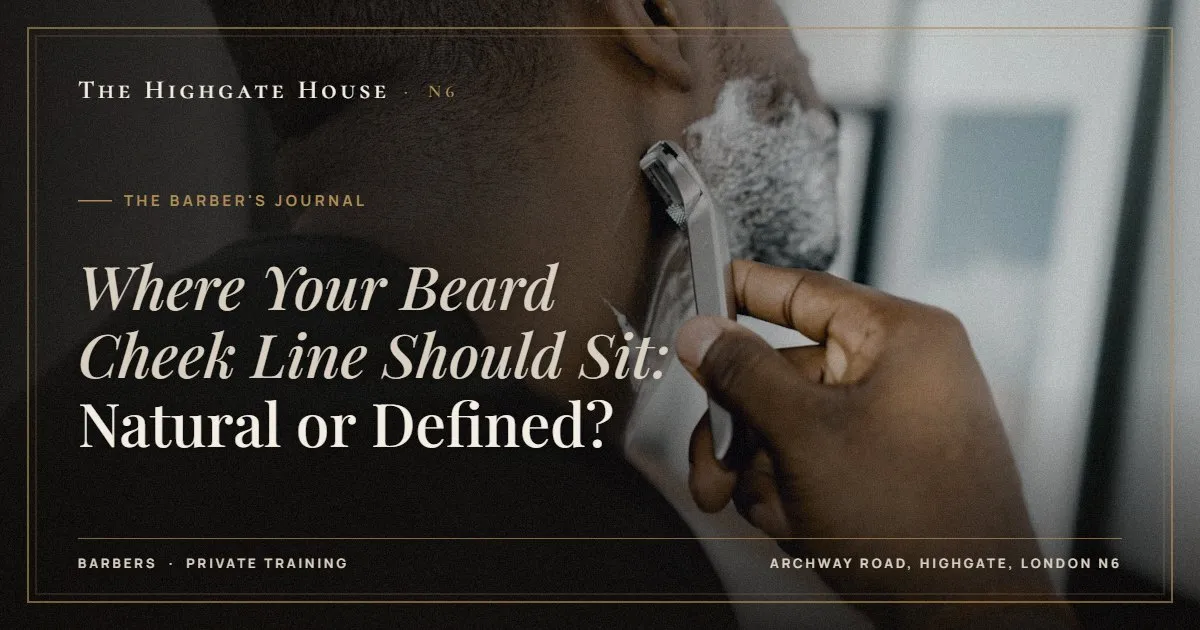
Where Your Beard Cheek Line Should Sit: Natural or Defined?
For most men, the beard cheek line should sit at or just below where the beard naturally stops growing densely, running from the bottom of the sideburn to the corner of the moustache. Keep it natural if your beard is full or long, if your growth line is already reasonably even, or if you do not want to maintain an edge. Define it if your beard is short, your top line is scattered with stray hairs, or you want a sharper, more formal look. The rule that saves most beards: clean up above the line, never cut into it. A cheek line taken too low makes the beard look small and the face wider.
What the cheek line actually is
The cheek line is the upper border of the beard on each side of the face. It starts where the sideburn meets the beard, roughly level with the bottom of the ear, and runs diagonally down and forward to the corner of the moustache. Most men have a natural line here already, but it is rarely clean: there is usually a band of sparse, lighter hairs above the dense growth, and the line is rarely identical on both sides.
It is the partner of the neckline below the jaw, and the two need to work together. A beard with a carefully set neckline and an untouched cheek line can look unbalanced, and vice versa. If you have not sorted the lower border yet, our guide to where your beard neckline should sit covers it.
How to find where yours should sit
Stand in good, even light, ideally daylight from a window in front of you, not overhead bathroom light which hides fine hairs. Then:
Find your dense line. Look for where the beard changes from solid growth to scattered hairs. That transition is your natural line. Everything above it is a candidate for removal.
Check the start and finish. At the top, the line should meet the sideburn smoothly with no step. At the bottom, it should meet the moustache corner without a notch.
Compare the sides. Use a hand mirror to look at both sides at once, or take a photo straight on. Most faces are slightly asymmetric; the aim is for the lines to look even, not to be measured identically.
Decide the shape. A straight diagonal line looks sharper and more modern. A gentle curve, following the cheekbone, looks softer and more natural. Very few men suit a dramatic curve.
Natural, tidied or defined: which to choose
Option | What it involves | Best for | Upkeep |
|---|---|---|---|
Natural | Leave the growth line alone; remove only obvious strays high on the cheek | Full and long beards; men who want a rugged look | Very low |
Tidied | Clear the scattered band above the dense line and straighten it slightly | Most beards, most offices | Every week or two |
Defined | A crisp, razor-sharp edge, often with a hot towel and straight razor | Short boxed beards, events, men with dark hair and fair skin | Every few days to hold the edge |
A few factors push the decision one way or the other:
Beard length. A long beard with a sharp line can look painted on. Short beards benefit most from definition, which is why the short boxed beard almost always has a defined cheek line.
Contrast. Dark hair on fair skin makes every regrowing hair visible, so a sharp line shows stubble within a day or two. Lighter or greyer beards are more forgiving.
Density. If your cheeks are patchy, a natural or tidied line works better than a hard edge, which draws attention to gaps just below it. Our post on patchy beards has more on working with sparse areas.
Skin. If you are prone to razor bumps or ingrown hairs, shaving a hard line every few days can irritate. A trimmer-cleaned line is kinder.
The mistake almost everyone makes: going too low
Lowering the cheek line is the single most common home-trimming error. It happens gradually: each tidy-up takes a millimetre or two from the top, because it is hard to see exactly where the line was, and over a few months the beard creeps down towards the jaw.
The effect is consistent. The beard looks smaller and thinner, the bare cheek above it looks broader, and the face reads rounder. On some men it starts to resemble a chinstrap. Growing it back takes weeks, and the hairs that return are the sparse ones, so it often looks patchy while it recovers.
Two habits prevent it. First, only remove hair that is clearly above the line, never trim into the dense growth. Second, set the line once with a barber, then just maintain what they set rather than redrawing it each time.
Trimming the cheek line at home
Between barber visits, a light tidy keeps it sharp. A careful method:
Trim on a dry beard. Wet hair lies flat and looks longer and lower than it is.
Brush the beard down so the line shows clearly.
Use a detail trimmer or a guard-free trimmer, held flat against the cheek, blade pointing down.
Work above the line only, in short downward strokes from the sideburn towards the moustache.
Do one side, then match the other, checking straight on in the mirror after each few strokes.
Stop sooner than you think. If in doubt, leave it. A few stray hairs look better than a line that is a few millimetres too low.
If you want a razor-sharp finish at home, use a single-blade razor on the cheek only, above the line, with a good shaving cream. Shave with the grain to reduce irritation. If you get red bumps or spots where you shave the line, the British Association of Dermatologists' page on folliculitis explains what is going on and when to get it looked at.
What happens when a barber does it
At The Highgate House, every visit with the Highgate Cuts team starts with an assessment: the barber looks at your beard, your growth line and how you wear it, then makes recommendations. For the cheek line that usually means agreeing the height and shape together before anything is removed.
The barber will then usually trim the beard to length, set the neckline, and then work on the cheek line, often with a trimmer to establish it and, for a defined finish, a straight razor to sharpen it. Where a hot towel is part of the service it softens the hair and skin so the edge is cleaner and kinder to the skin. Done once properly, the line is far easier to maintain at home because you can see exactly where it is. Our barber services page lists what is on offer, from beard work to hot towel shaves.
A quick cheek line checklist
Good light, dry beard, brushed down.
Line runs from the bottom of the sideburn to the moustache corner.
Remove only the scattered band above dense growth.
Straight diagonal or a gentle curve, not a dramatic arc.
Both sides look even from the front.
Neckline and cheek line match in sharpness.
When unsure, leave it for the barber.
Questions we get asked
Should I shave my cheek line or trim it?
Trimming is enough for most men and causes less irritation. Shaving gives a sharper edge but shows regrowth quickly and needs doing every few days.
My cheek line is too low. How do I fix it?
Only time fixes it. Stop trimming the top completely and let it grow back for several weeks, tidying the rest of the beard so it still looks deliberate. Then have a barber set the line; beard work at Highgate Cuts starts with exactly that conversation.
Why are my cheek lines uneven?
Most faces and growth patterns are slightly asymmetric. Aim for lines that look even from the front, rather than chasing identical heights, which often ends in both being too low.
How often should the cheek line be tidied?
A tidied line needs attention every week or two at home. A sharp, defined line needs it every few days. A barber reset every few weeks keeps the height right. Our guide to how often to trim a beard covers the full rhythm by length.
Book with The Highgate House
Ready for a proper cut? Email us at [email protected] with the service and the day that suits you, and we will come back to you with times.
Visit The Highgate House · The barbers
The Highgate House, Archway Road, Highgate, London N6.
