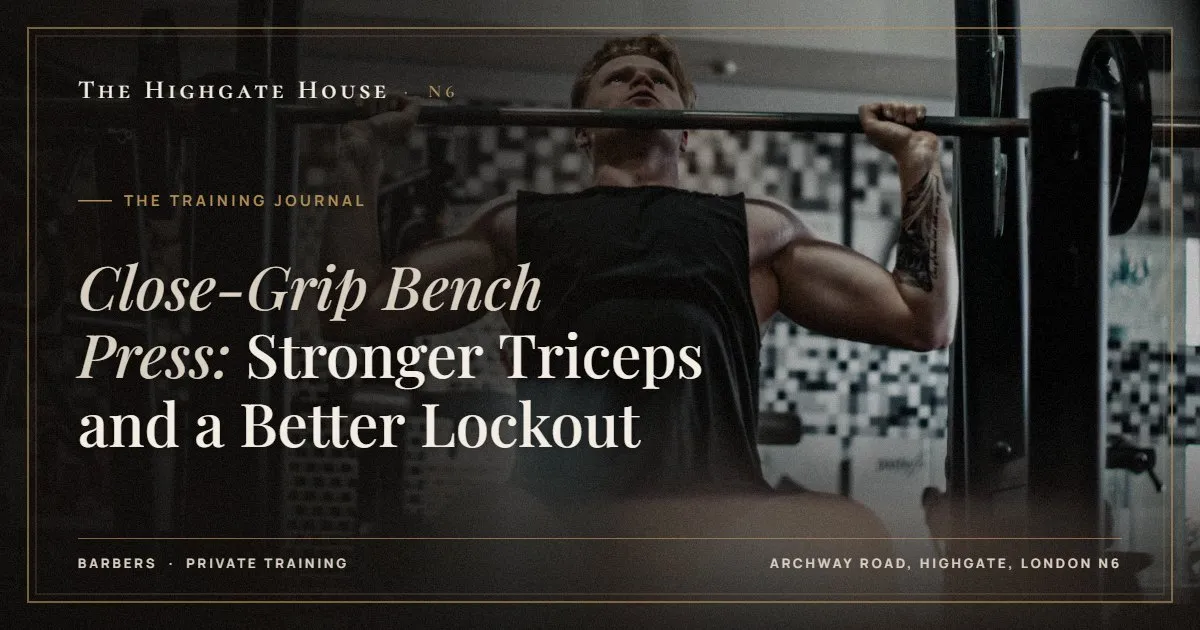
Close-Grip Bench Press: Stronger Triceps and a Better Lockout
The close-grip bench press is a bench press with the hands roughly shoulder width apart, or slightly inside, instead of the wider grip most people use. Narrowing the grip keeps the elbows closer to the body, increases the range of motion and shifts more of the work onto the triceps, while the chest and front shoulders still contribute. That makes it one of the best compound exercises for building triceps strength and for improving the top half of a normal bench press, where the arms have to straighten. The common mistake is going too narrow. Hands almost touching do not make it more effective; they mostly make it harder on the wrists.
Why the narrower grip changes the exercise
On a standard bench press, the wider grip lets the chest do a large share of the work and shortens the distance the bar travels. Bring the hands in and two things happen. The elbows travel closer to your sides, which puts the triceps in a stronger position to contribute, and the bar travels further, so each rep does more work.
The practical result is an exercise that builds pressing strength through the whole arm. It also tends to be kinder to the shoulders than a wide grip for many people, because the elbows are not flared out to the sides. If you get shoulder discomfort on a normal bench, our guide to bench press shoulder pain goes through setup fixes worth trying first.
How to set up and perform it
- Find your grip. Lie on the bench and place your hands so that the inside of each hand is roughly in line with the outside of your shoulders. For most people that is about shoulder width. Index fingers on or just inside the smooth part of the bar is a common reference.
- Set your upper back. Pull the shoulder blades back and down, plant your feet and keep your backside on the bench. The same setup as a normal bench; our bench press form guide covers it in detail.
- Stack the wrists. The bar should sit low in the palm, over the forearm bones, with the wrists only slightly bent back.
- Unrack and steady. Bring the bar over your shoulders with straight arms.
- Lower with tucked elbows. Let the elbows travel down at roughly 30 to 45 degrees from your body. The bar will touch lower than on a wide-grip press, typically around the lower chest or the bottom of the breastbone.
- Touch and press. Touch lightly, without bouncing, then press up and slightly back towards the rack so the bar finishes over your shoulders.
- Lock out fully. Straighten the arms at the top each rep. That last few inches is where the triceps do their most obvious work.
Always use a spotter or safety arms set just above chest height when you press with a barbell. Pressing alone without safeties is the one bench press mistake that can go badly wrong in an instant.
How narrow is too narrow
Hands six inches apart is an old-fashioned version you still see. It rarely helps. At that width the wrists bend sharply outward, the elbows flare to compensate, and you lose the very elbow position that makes the exercise useful. Most lifters do well somewhere between shoulder width and a hand’s width inside it.
| Grip | What you will notice | Verdict |
|---|---|---|
| Shoulder width | Wrists straight, elbows tucked naturally, strong triceps feel | The default for most people |
| Slightly inside shoulders | More triceps, longer range | Good if wrists stay comfortable |
| Hands nearly touching | Wrist strain, elbows flare, bar unstable | Not recommended |
Common faults
Flaring the elbows
If the elbows drift out as the bar comes down, you have turned it back into a normal bench with a narrow grip, the worst of both. Think about bending the bar into a U shape to keep the elbows in.
Touching too high
Bringing the bar to the upper chest with a close grip forces the shoulders into a poor position. Let it come lower, where it naturally lands with tucked elbows.
Bent-back wrists
A bar sitting near the fingers bends the wrists backwards. Move it into the heel of the palm.
Partial reps
Stopping short of the chest or short of lockout cuts out the most useful part of the movement. Use a weight you can move through the full range.
Programming the close-grip bench
There are two common ways to use it.
- As a secondary press. After your main bench, three or four sets of six to ten reps. This is the most common use and works well for most people.
- As a main press for a block. If your bench stalls near lockout, or your shoulders do not tolerate a wide grip, four to six weeks with the close-grip version as your main press, in sets of four to six, can help. If you are stuck, our piece on bench press plateaus lists other fixes.
Expect to handle a bit less weight than on a normal-grip bench for the same reps. Add weight in small steps once you can complete all your sets with good form.
If you have a shoulder, elbow or wrist injury, a heart condition, are pregnant or are returning after a long break, check with your GP first. The NHS guide to strength exercises is a sensible starting point if you are new to resistance training.
Alternatives if you cannot bench
Dumbbell presses with a neutral grip (palms facing each other) and elbows tucked give a similar training effect with more freedom for the wrists and shoulders. Cable triceps work, such as pushdowns and overhead extensions, builds the triceps directly without any pressing load on the shoulder. In a coached session we choose between these based on how your joints respond, not on a fixed rule.
That is a big part of what 1-1 personal training in Highgate is for: picking the version of an exercise that suits your body and coaching it properly. Our current plans and prices are on the personal training page.
Questions we get asked
Does the close-grip bench work the chest?
Yes. The chest is still heavily involved; the triceps simply take a larger share than on a wide-grip bench.
Is it better than dips for triceps?
Both are effective. The close-grip bench is easier to load gradually and is often more comfortable for shoulders that dislike deep dips.
Why do my wrists hurt?
Usually the grip is too narrow or the bar is sitting too close to the fingers. Widen slightly and set the bar in the heel of the palm.
Can I do it with an EZ bar or dumbbells?
Dumbbells with palms facing each other work well. EZ bars are less common for pressing, so check the bar suits your bench and rack first.
Book with The Highgate House
Ready to start training properly? Email us at [email protected] with the service and the day that suits you, and we will come back to you with times.
Visit The Highgate House · Private personal training
The Highgate House, Archway Road, Highgate, London N6.
