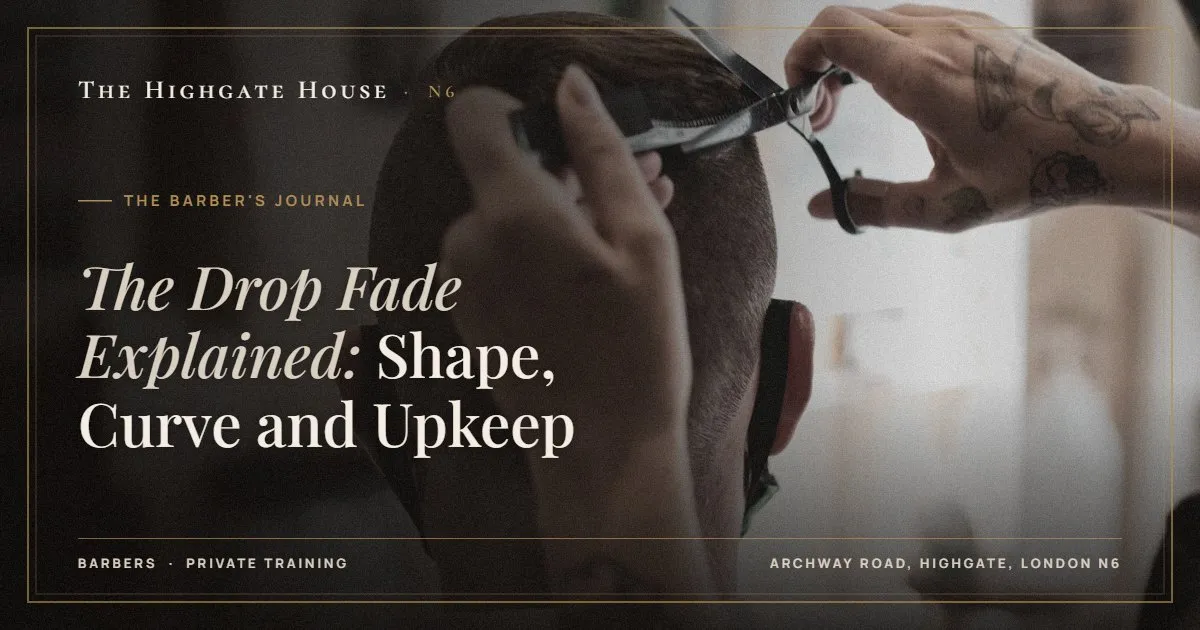
The Drop Fade Explained: Shape, Curve and Upkeep
A drop fade is a fade whose shortest line is not level. It sits higher at the temple and above the ear, then dips down behind the ear towards the nape, tracing an arc rather than a straight band around the head. The point is shape: the curve follows the natural line of the skull, so the cut looks fuller at the back and cleaner at the sides than a flat fade of the same length. It suits most head shapes, works at low, mid or skin level, and needs a tidy-up every two to four weeks depending on how short the bottom goes.
What makes a drop fade different
Most fades are described by height: low, mid or high. That height is usually measured as if the fade line runs horizontally around the head. On a real head it never quite does, because the skull narrows and drops behind the ear before it widens again at the occipital bone, the bump at the back. A straight band cut across that geometry can leave the back looking boxy or, on some heads, oddly hollow just behind the ear.
The drop fade solves this by letting the line fall. Behind the ear, the barber brings the shortest part of the fade down by a centimetre or two, then carries it round to the nape at the lower level. The result is a gentle “C” shape when you look at the side of the head. The hair above the curve keeps its weight at the occipital, which is exactly where most people need a little volume.
It is a variation on placement, not a different technique. If you want the full mechanics of how a blend is built, our guide to what a fade haircut is walks through it step by step.
Who the drop fade suits
The curve is forgiving, which is why barbers often reach for it when a client is unsure. It is particularly good for:
- A flat back of the head. Keeping length above the dip at the occipital adds shape where the skull has little. A level high fade would expose the flatness.
- A prominent ridge or bump. The line can be placed to sit below or follow a ridge rather than cutting across it.
- Ears that stick out. Leaving slightly more weight above and behind the ear reduces the contrast that makes ears look bigger.
- Beards. Because the front of the fade sits a little higher at the sideburn, it hands over to a beard more naturally than a low, level line.
Where it is less useful: very short all-over cuts, where there is no length on top for the curve to contrast against, and heads with a very pronounced double crown where the swirl sits right on the line. Neither rules it out, but both need a conversation first.
Low, mid or skin: choosing the version
A drop fade can start at almost any height. What changes is how much the curve shows.
| Version | Where the line sits | Effect | Good for |
|---|---|---|---|
| Low drop | Just above the ear, dipping close to the nape | Subtle; the curve is felt more than seen | Office wear, a first fade, longer gaps between cuts |
| Mid drop | Around the temple, dropping behind the ear | The arc is clearly visible from the side | Crops, comb overs, textured tops |
| Skin drop | Any height, with the bottom band shaved to skin | Maximum contrast along the curve | People happy to rebook every two weeks |
A burst fade is a close relative: the fade circles the ear and stops before reaching the nape, leaving length at the back. A drop fade continues all the way round. If you like the curve but want a mohawk or mullet line at the back, it is the burst you are after.
How to ask for a drop fade
The name alone covers a lot of ground, so give the barber the details that change the result:
- Starting height at the temple. Point to it. “Level with the top of my ear” is clearer than “mid”.
- How far it drops. A gentle dip or a pronounced arc. A pronounced drop looks deliberate and stylised; a gentle one simply looks well shaped.
- The shortest length. Skin, or a short guard. If you are unsure of the numbers, our explainer on clipper guard numbers converts them to millimetres.
- The top. Length, whether it goes forward, back or to the side, and whether it is scissor cut.
- The edges. Natural or lined up at the temples, and a faded or squared neckline.
Every visit with the Highgate Cuts barbers starts with an assessment, so the barber will look at your hair and head shape before suggesting where the curve should sit. Use that moment. If you have had a drop fade elsewhere that you liked, a photo of the back and side is more useful than a photo of the front.
What happens in the chair
The barber usually maps the curve first with a guard, cutting a guideline that runs from the temple, over the ear and down behind it. That line is checked from both sides before anything goes shorter, because symmetry is the hard part: the two ears rarely sit at exactly the same height, and a curve that matches the ears can look lopsided against the head. A good barber will balance it against the head, not the ears.
Then the fade is built upward from the line in the usual way, closing the gaps between lengths with the clipper lever, guards and, for a skin version, a foil shaver. The arc behind the ear gets the most attention because it is where blending is hardest; the head is curving away in two directions at once. Expect the barber to tilt your head forward and to the side a lot.
How a drop fade grows out
One of the drop fade’s quiet strengths is the grow-out. Because the bottom line follows the skull, the cut keeps its outline longer than a level fade, even when the blend has softened.
- Week one. Sharpest contrast, the curve clearly visible.
- Week two. The shortest band shadows over; the curve is still readable from the side.
- Weeks three to four. The blend has compressed and the cut reads as tidy short sides with good shape at the back.
- Beyond four weeks. Hair above the ear starts to push outward and the shape is lost.
Most people rebook at two to three weeks for a skin drop and three to four for a low drop with a guard at the bottom. Booking the next cut on the way out saves the drift that happens when you mean to call “next week”.
Upkeep between visits
- Leave the curve alone. The arc behind the ear is the hardest thing to recreate with a home trimmer and the first thing to go wrong.
- If you tidy the neck, stay well below the barber’s work and do not touch the dip.
- Close shaving at the nape can cause ingrown hairs, particularly on curly hair. If bumps keep appearing, ask for a guard rather than skin at the bottom. The NHS page on ingrown hairs explains prevention and when to get them checked.
- Use a matte product on top. The drop fade is about shape, and shine on top competes with it.
Common mistakes
The most frequent is asking for too much drop. An exaggerated arc can look dated quickly and grows out unevenly. The third is matching the curve to the ears rather than the head. If one ear sits lower, the fade should still look balanced from behind; ask the barber to check it with a hand mirror.
If you are torn between this and a straight low fade, our piece on the low fade covers the level version and when it is the better choice.
Getting a drop fade on Archway Road
The Highgate Cuts team is on the ground floor of The Highgate House, a corner building on Archway Road, about five minutes’ walk from Highgate tube, with clients coming in from Archway, Crouch End, Muswell Hill and Hampstead. Fades, scissor cuts, beard work and hot towel shaves are all listed on the barber page. For prices, see the barber menu or email us.
Questions we get asked
Is a drop fade the same as a burst fade?
No. Both curve around the ear, but a burst fade stops before the nape and leaves length at the back. A drop fade continues all the way round the head at the lower level.
Does a drop fade work with straight hair?
Yes. Straight hair shows the line of the curve very clearly, so it needs precise blending, but the shape works with any texture.
Can I go from a regular fade to a drop fade in one visit?
Usually, as long as there is enough length behind the ear to place the curve. If your last fade went high at the back, you may need one cut of growth first.
How long does a drop fade take?
Slightly longer than a level fade, because the curve is mapped and checked from both sides. Do not squeeze it in before a meeting.
Book with The Highgate House
Ready for a proper cut? Email us at [email protected] with the service and the day that suits you, and we will come back to you with times.
Visit The Highgate House · The barbers
The Highgate House, Archway Road, Highgate, London N6.
