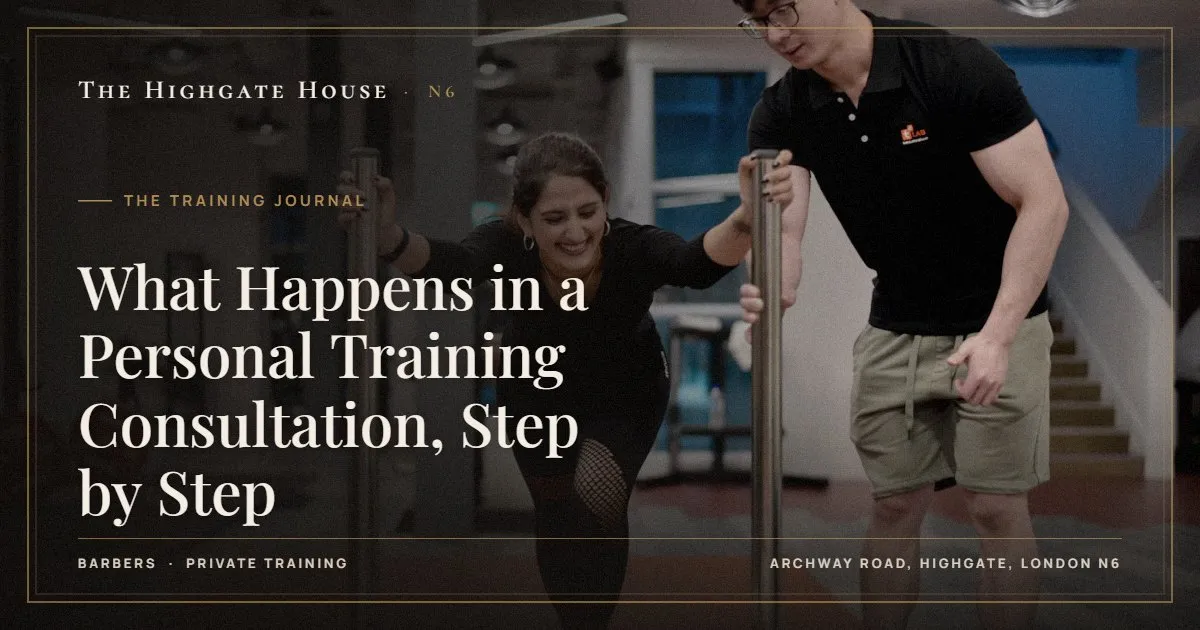
What Happens in a Personal Training Consultation, Step by Step
A personal training consultation is a structured conversation, usually 30 to 45 minutes, in which a trainer finds out whether they can help you and you find out whether you want them to. It covers a health screening questionnaire, your goals and the reasons behind them, your training history and injuries, the realities of your week, and a straight discussion of what working together would involve. There is little or no exercise. You should leave with a clear recommendation, an honest timeframe and enough information to decide, without being pressed to sign anything on the spot.
The consultation is not the first session
People often blur the two. The consultation is a decision meeting: is this the right trainer, the right approach, the right time? The first session is where the training begins, with movement checks and a first workout. We cover that hour in detail in your first personal training session. Some trainers fold both into one appointment. That is fine, as long as the questions below still get asked properly and you are not deciding with your heart rate at 160.
Step 1: the health screening
Most UK trainers use a version of the PAR-Q (Physical Activity Readiness Questionnaire), a short set of yes or no questions about your heart, blood pressure, chest pain, dizziness, joint or bone problems, medication and anything else a doctor has told you about exercise. It takes five minutes. It is not paperwork for its own sake. A “yes” on certain questions means the sensible next step is a conversation with your GP before training starts, and a good trainer will say so plainly rather than wave it through.
You should be asked to check with your GP first if, for example, you have a heart condition, have had chest pain on exertion, have uncontrolled blood pressure, are pregnant or recently postnatal, are recovering from surgery, or have not exercised at all for a long time and have other health concerns. The NHS exercise guidance makes the same point.
Anything you share stays between you and the trainer. You do not have to disclose more than you are comfortable with, but the more the trainer knows, the better the programme.
Step 2: the goal, and the goal behind the goal
“Lose a stone” or “get stronger” is where this part starts, not where it ends. The useful questions come next:
- Why now? Something usually prompted the enquiry: a birthday, a photo, a doctor’s comment, a back that has started complaining.
- What would be different in six months if this worked? The answers are often practical. Carrying the children without wincing. Skiing a full week. Feeling sharp at 4pm.
- What have you tried before, and why did it stop? This tells a trainer more than any fitness test.
A trainer who writes down “weight loss” and moves on has missed most of the information. The deeper answer shapes everything: exercise choice, session length, how progress is measured. Our guide to setting fitness goals you will actually hit goes further into turning a vague aim into something you can track.
Step 3: history, injuries and how you live
This is the longest part, and for busy professionals over 30 it is where the plan is really made. Expect questions about:
- Training history. Sport at school, gym phases, running, classes. Past competence comes back faster than people expect.
- Injuries and niggles. Old and current, including ones you think are irrelevant. A shoulder dislocated at 22 matters for overhead pressing at 45.
- Work pattern. Hours, travel, how predictable your diary is, when your energy is best.
- Sleep, stress and alcohol. Not to lecture you, but because they determine how much training you can recover from.
- Eating. A rough picture of a normal day, not a food diary.
Why the “real week” question matters most
The single biggest predictor of whether training works is whether it fits. If you travel twice a month and have board meetings that overrun, a plan that assumes three fixed sessions a week will fail by February. A good consultation designs around the week you actually have, with a minimum version for the weeks that go wrong.
Step 4: the recommendation
By now the trainer should be able to tell you, specifically, what they would suggest. Roughly:
- How many sessions a week, and how long each.
- What you would do between sessions, if anything.
- What the first four to six weeks would focus on.
- How progress would be measured, and when it would be reviewed.
- A realistic sense of how long meaningful change takes for someone in your position.
Be wary of anything that sounds too clean. Honest timeframes come with caveats about sleep, work and consistency. If you are offered a guaranteed result, ask what it is based on.
Step 5: your questions and the decision
The last ten minutes are yours. It is a good time to ask about qualifications, experience with people like you, how sessions are cancelled or moved, and what happens if something hurts. We list the most useful ones in 10 questions to ask a personal trainer.
You should not be pressed for an answer there and then. A trainer confident in what they offer is happy for you to go away and think about it.
A quick checklist to bring with you
- Any medication you take, by name.
- Dates of past injuries or operations, roughly.
- Your diary for the next month, so you can talk about real slots.
- One sentence on what you want, and one on why.
- Anything you have tried that did not work, and your honest view of why.
- Any results from a recent GP check, if relevant and you are happy to share.
Signs the consultation went well, or did not
Good signs: the trainer talked less than you did, asked follow-up questions, explained the reasoning behind their suggestion, mentioned what they would not do with you yet, and was clear about anything that needed a GP’s view first.
Less good signs: a generic plan that could have been written before you arrived, a hard sell on the largest package, dismissal of an injury, or a body-fat measurement used to make you feel bad rather than to set a baseline.
How we run consultations at the studio
At The Highgate House on Archway Road, the consultation takes place in the private basement studio, so you see the space and the equipment, including the squat rack, cable station and air bike, before you commit. If you would like a baseline reading, the InBody body composition scan can be done then or saved for the first session; it is optional either way. Every consultation ends with a written recommendation you can take away. If coached one-to-one training in Highgate sounds like the right fit, we arrange sessions in early mornings or evenings around your week. If it is not the right fit, we will say so and, where we can, point you somewhere better suited.
The studio is for coached sessions only, so the consultation is also where we agree the regular slots you will train in. You can read more about how sessions run on our personal trainer page.
Questions we get asked
Do I need to wear gym kit to a consultation?
Not usually. Wear whatever you are comfortable in. If you plan to have a scan or try a few movements, comfortable clothes and flat shoes are easiest.
Do I have to be scanned or weighed?
No. A baseline helps track progress later, but it can wait until you feel ready, and some people prefer to track strength and measurements instead.
What if my GP says to wait?
Then we wait, or we agree a gentler starting point within whatever your GP has advised. Training can usually be adapted; it should never be forced.
How long until I can start?
Often within a week, depending on available slots. If a GP check is needed, it starts once you have had that conversation.
Book with The Highgate House
Ready to start training properly? Email us at [email protected] with the service and the day that suits you, and we will come back to you with times.
Visit The Highgate House · Private personal training
The Highgate House, Archway Road, Highgate, London N6.
