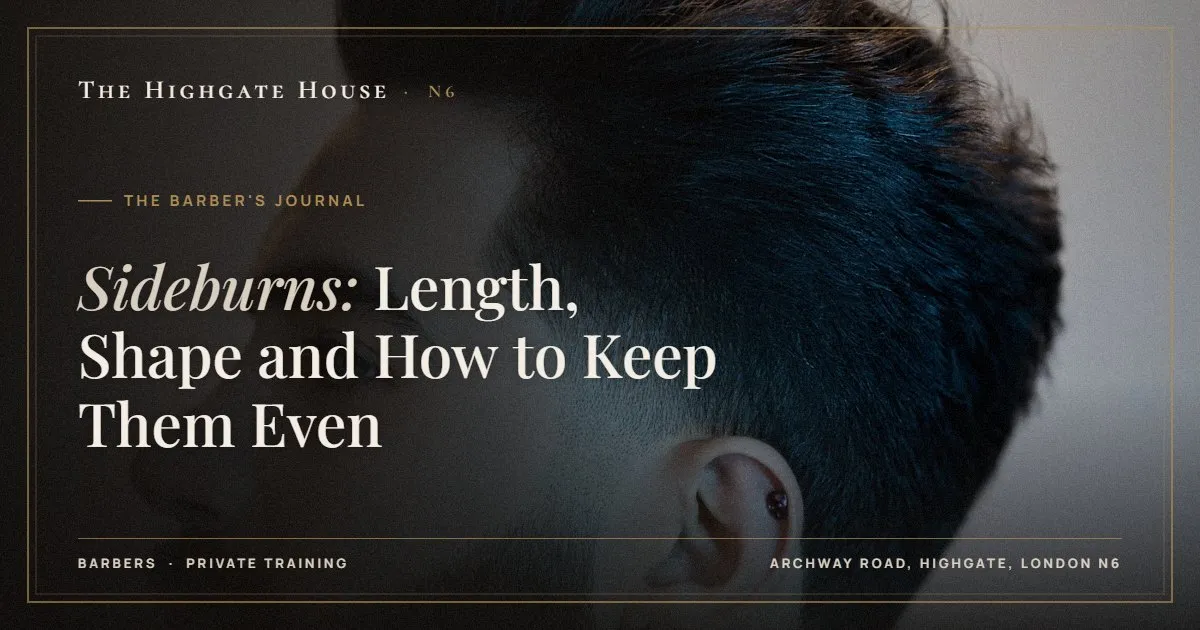
Sideburns: Length, Shape and How to Keep Them Even
For most men the right sideburn length sits around the middle of the ear, roughly level with the opening of the ear canal. Go shorter, towards the top of the ear, if your face is long or you wear a short, tight cut; go a little longer, towards the lobe, if your face is round or wide or you have a beard to connect to. The shape should follow the haircut: squared and crisp for classic cuts, faded into skin for modern short styles. Keeping them even comes down to measuring against fixed points on your face, not against each other in the mirror.
Sideburns are a small area that has an outsized effect on how a cut reads. They frame the face, and when one sits two millimetres lower than the other, people notice without quite knowing what they are noticing.
Choosing a length for your face
Think of the sideburn as a vertical line that either lengthens or shortens the face. A long sideburn draws the eye down the side of the head; a short one stops it high and widens the look of the upper face.
| Where it stops | Effect | Tends to suit |
|---|---|---|
| Top of the ear | Clean, modern, shortens the face | Long or narrow faces, high fades, crops |
| Mid-ear | Neutral, the safe default | Oval faces, most classic and scissor cuts |
| Bottom of the lobe | Lengthens and slims the face | Round or wide faces, longer hair |
| Below the lobe | Deliberate, retro or rock | Men committing to a style; or joined into a beard |
Two other things shift the choice. Glasses arms run right across the sideburn, so very long, heavy ones can look crowded under frames. And a receding or high temple area often looks better with a slightly fuller sideburn, which keeps some weight at the side of the face. For more on matching the whole cut to your features, see choosing a haircut for your face shape.
Shape: the bottom edge matters as much as the length
Square
A horizontal line at the bottom. Classic, tidy and the most common choice with short back and sides or a scissor cut. It looks sharp for about a week and needs the most upkeep, because any regrowth below the line is visible.
Tapered or faded
The sideburn gets gradually shorter as it goes down until it blends into skin. This is the usual finish on a skin fade or taper, and it grows out more gracefully than a square line. If your sides are faded, a squared sideburn sitting on top of the fade usually looks stuck on.
Angled
The bottom edge follows the angle of the jaw, sloping slightly forward. It gives a slimmer, more angular look and can suit a round face.
Connected to a beard
With a beard, the sideburn becomes the bridge between hair and facial hair. The usual approach is to fade the sideburn from the haircut length into the beard length so there is no visible step. Our post on the beard fade covers how barbers blend that join.
How barbers keep them level
The mirror is a poor judge of symmetry because you are looking at a reversed image, and most people tilt their head slightly to one side without realising. A barber does not compare one sideburn with the other by eye alone. Instead:
- The head is levelled first. Chin parallel to the floor, eyes looking straight ahead. A tilted head is the most common cause of uneven sideburns.
- Each side is measured against a fixed landmark on that side, usually the cartilage at the front of the ear canal or the bottom of the cheekbone.
- Two fingers or a comb laid horizontally across the face from one sideburn towards the other check the line from the front.
- Ears are not trusted. Almost nobody’s ears sit at exactly the same height. If you match sideburns to your ears and the ears are uneven, so are the sideburns. Barbers match to the eyes and nose instead.
At Highgate Cuts the sideburns are part of the assessment that starts every visit. If you have one ear noticeably higher than the other, it is worth mentioning, so the line can be set to look level from the front rather than measure level against the ears.
Trimming them evenly at home
Between cuts, a quick tidy keeps them sharp. Do less than you think.
- Comb the sideburn down so you can see its true length.
- Pick a landmark on each side, the same one, before you start. The front of the ear canal is the most reliable.
- Trim the bulk first with a trimmer guard that matches your barber’s, moving downwards. If you do not know the number, ask at your next visit.
- Set the bottom line on your less steady side first. Right-handed men usually find the left side harder. Do it first, then match the easier side to it.
- Remove the guard and take the line up by one millimetre at a time. Never try to set the line in one pass.
- Check from the front with your head level, using a second mirror or your phone camera on a timer rather than a reversed mirror image.
- Stop when it is close. Chasing a perfect match is how a mid-ear sideburn ends up at the top of the ear.
Leave the fade itself to the barber. Blending is very hard to do on yourself, and a hard line cut into a faded side is difficult to hide. Our guide to maintaining a haircut between visits covers which tidy-ups are safe at home and which are not.
Common mistakes
- Chasing symmetry: taking a bit more off each side alternately until both are too short. They take two to three weeks to grow back to a sensible length.
- Shaving too high with a razor: when shaving the cheeks, men often catch the bottom of the sideburn. Shave up to it, not into it. If the skin along that edge gets bumpy, it is usually ingrown hairs; the NHS guidance on ingrown hairs covers sensible shaving habits.
- Thick, bulky sideburns: length is fine, weight is the problem. Trimmed shorter in thickness, a long sideburn looks neat rather than heavy.
- Ignoring the front edge: stray hairs growing forward onto the cheek make a sideburn look untidy even when the length is right.
Growing them longer
If you want a longer sideburn, tell your barber at least one visit ahead so they stop taking it up. Most sideburns grow back to mid-ear in two or three weeks from a short cut, but filling out evenly can take longer. Keep the edges tidy while you wait, because a clean front and back edge makes an in-between length look intentional.
Questions we get asked
How long should sideburns be?
Mid-ear suits most men. Shorter for long faces and tight cuts, longer for round faces or when joining a beard.
Why does one sideburn always look shorter?
Usually because the head was tilted while trimming, or the line was matched to ears that sit at different heights. Level the head and use the same facial landmark on each side.
Should sideburns be faded or squared?
Match the haircut. Faded sides call for faded sideburns; classic scissor cuts and short back and sides usually look best squared.
Do sideburns grow back if I cut them too short?
Yes. Trimming does not affect how hair grows back. Expect two to three weeks to regain a usable length.
Book with The Highgate House
Ready for a proper cut? Email us at [email protected] with the service and the day that suits you, and we will come back to you with times.
Visit The Highgate House · The barbers
The Highgate House, Archway Road, Highgate, London N6.
